
Over two days, an estimated 50,000–60,000 people crossed from Morocco into Ceuta, overwhelming the border of a Spanish city with a population of approximately 85,000. At least 67 people died, either by drowning or in crushes near the border infrastructure. More than 48,000 subsequently returned to Morocco (Pons and Gore, 2026).
The event was simultaneously a humanitarian disaster, a failure of border control and a political crisis. What caused it, however, is less certain.
This article reflects information available on 2 August 2026. Figures and findings may change as further evidence emerges.
Why is Ceuta part of Spain?
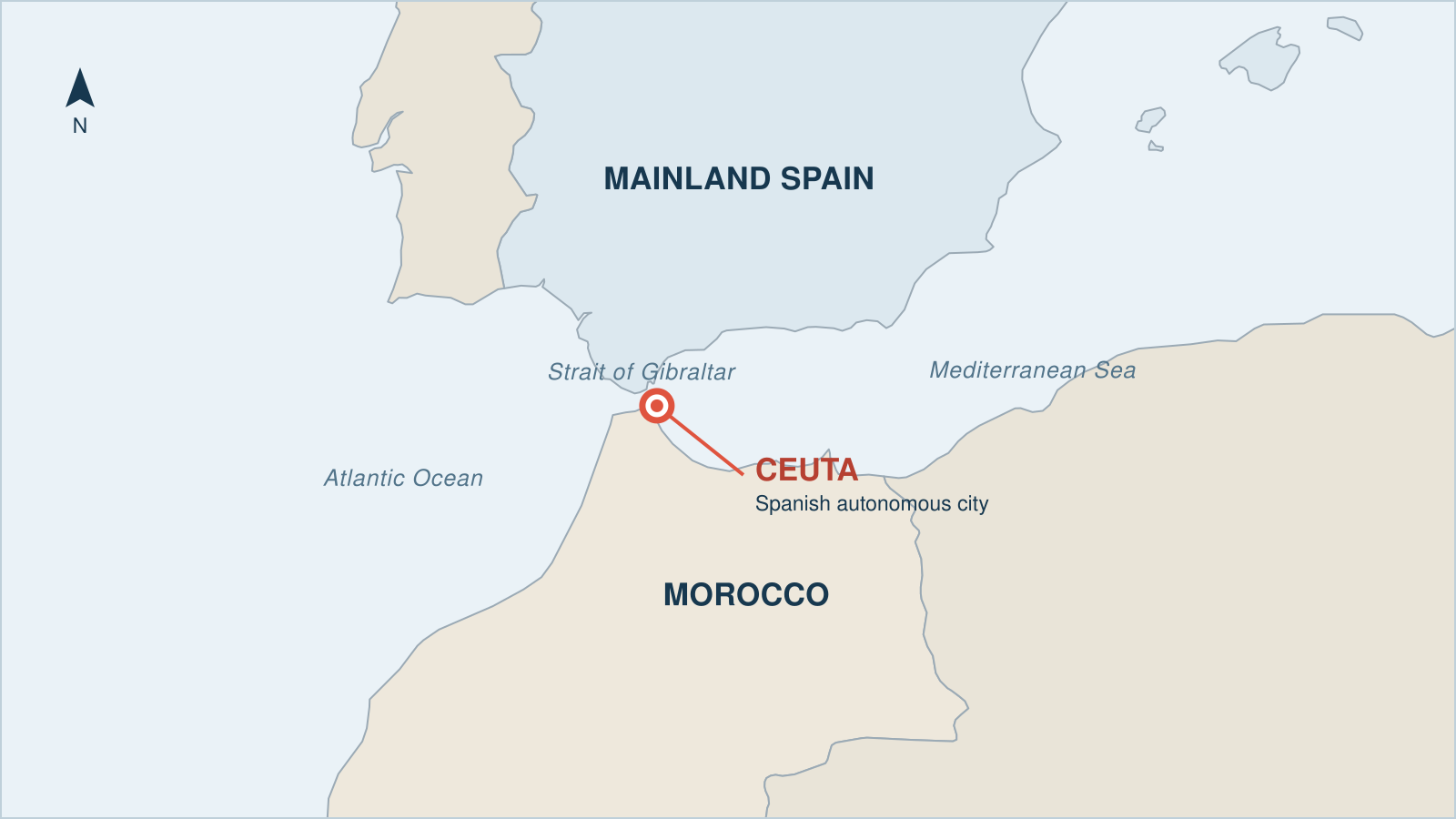
Ceuta’s location frequently creates confusion. It is situated on the African continent and shares a land border with Morocco, but it is an autonomous Spanish city.
The city was captured by Portugal in 1415. When the Portuguese and Spanish crowns were united in 1580, Ceuta came under the Spanish Crown. It remained aligned with Spain when Portugal regained its independence, and Portuguese recognition of Spanish control was formalised in the 1668 Treaty of Lisbon. Morocco does not recognise Spanish sovereignty over Ceuta or the nearby city of Melilla. Spain maintains that both are integral parts of its national territory.
Ceuta and Melilla are also the European Union’s only land borders with Africa. This makes them recurring destinations for people attempting to reach Spanish and European territory. (Naishadham, 2026)
What caused the mass crossing?
No single cause has been established.
Economic hardship and youth unemployment help explain why many Moroccans wanted to leave. Social-media posts reportedly then claimed that the border was open and circulated instructions for entering Ceuta. Images of successful crossings may have encouraged thousands more to follow.
The posts also referred to a recent Spanish Supreme Court ruling. The court found that migrants arriving by sea could not be immediately returned under provisions covering people intercepted while crossing a physical land barrier. It did not grant migrants an automatic right to remain in Spain (General Council of the Judiciary, 2026).
Spanish authorities allege that trafficking networks misrepresented the ruling. Available evidence supports the conclusion that misinformation contributed to the crossing, but it does not yet establish who began or coordinated the campaign (Wilson and Brito, 2026).
Did Spain’s immigration policy encourage it?
Critics blamed Spain’s regularisation program, which offers legal status to some undocumented migrants already living in the country.
The policy may have contributed to a general perception that Spain is comparatively welcoming. However, the people entering Ceuta in July were not eligible. Applicants had to show that they arrived before 1 January 2026 and had already lived in Spain continuously for at least five months (Brito, 2026).
It is reasonable to debate whether regularisation programs create longer-term incentives. It is not accurate to claim that the new arrivals automatically qualified for legal residency.
Did Morocco allow it to happen?
Morocco’s role remains unresolved.
In 2021, Moroccan authorities relaxed border enforcement during a diplomatic dispute with Spain, allowing approximately 8,000 people to enter Ceuta. This precedent makes current suspicions understandable.
During the latest crisis, witnesses initially saw Moroccan officers standing aside while crowds approached the border. Moroccan forces later used tear gas, batons and water cannons to stop further crossings. Morocco denied wanting the crisis, while Spanish ministers continued to describe it as a reliable partner (Wilson and Brito, 2026).
This raises legitimate questions about how tens of thousands reached the border without effective intervention. It does not yet prove that Morocco deliberately opened it.
Was Israel behind the crisis?
Social-media users have also alleged that Israel, or Israel and the United States together, encouraged Morocco to create the crisis as retaliation for Spain’s positions on Gaza, Iran and immigration.
The allegation gained attention after Israel’s UN ambassador Danny Danon criticised Spain’s migration policies and questioned its control of “colonial enclaves” in Africa. Spanish Transport Minister Óscar Puente responded that events were becoming “quite clear” (Kirikcioglu, 2026).
These statements establish political hostility and explain why suspicion spread. They do not establish operational involvement.
No publicly available evidence links the Israeli or US governments to the accounts promoting the crossing, the alleged trafficking networks or any Moroccan decision to relax enforcement (Wilson and Brito, 2026). Unless such evidence emerges, the allegation should be treated as unsubstantiated.
Humanitarian emergency or border crisis?
It was both.
The people crossing were individuals, many motivated by hardship and the hope of a better future. Their lives did not become less valuable because they entered without authorisation.
Spain nevertheless has a legitimate responsibility to control its border. Tens of thousands of unauthorised arrivals could not be accommodated safely by a city the size of Ceuta. Spain reinforced the border, deployed police and military personnel and installed a 500-metre floating maritime barrier following the deaths (Pons and Gore, 2026).
Protecting human life and maintaining an enforceable border are not contradictory objectives. Governments must be able to discourage dangerous, unauthorised crossings while respecting due process and asylum rights.
Several conclusions are currently supported by evidence: the border was overwhelmed, misinformation contributed to the surge, the humanitarian consequences were severe and the new arrivals were not eligible for Spain’s regularisation program.
Other claims, including that Morocco deliberately opened the border or that Israel and the United States orchestrated the crisis, remain unproven.
Acknowledging this uncertainty is not avoiding the issue. It is the difference between examining an event and simply fitting it into an existing political narrative.
References
- Brito, R. (2026) ‘Spain is granting legal status to immigrants lacking authorization—potentially 500,000 people’, Associated Press, 27 January. Accessed 2 August 2026.
- General Council of the Judiciary (2026) ‘El Tribunal Supremo confirma que la ley no permite las “devoluciones en caliente” de los migrantes que pretenden entrar a nado en Ceuta y Melilla’, 8 July. Accessed 2 August 2026.
- Kirikcioglu, M. (2026) ‘Spanish politicians, commentators accuse Israel of stirring chaos over Ceuta migration crisis’, Anadolu Agency, 31 July. Accessed 2 August 2026.
- Naishadham, S. (2026) ‘What to know about the Spanish territory of Ceuta as migrant arrivals from Morocco spike’, Associated Press, 31 July. Accessed 2 August 2026.
- Pons, C. and Gore, M.F. (2026) ‘Spain installs floating barrier in Ceuta after deadly migrant rush’, Reuters, 1 August. Accessed 2 August 2026.
- Wilson, J. and Brito, R. (2026) ‘Fact Focus: Migrant crossing in Spain’s Ceuta breeds unsubstantiated claims’, Associated Press, 1 August. Accessed 2 August 2026.