

On 13 June 2025, Israel launched a major military operation against Iran, striking nuclear facilities, air defences, missile infrastructure and senior Iranian officials. The Israeli government described the operation as a pre-emptive response to an existential nuclear threat.
Just over a week later, the United States entered the conflict. During Operation Midnight Hammer, US forces attacked the Iranian nuclear facilities at Fordow, Natanz and Isfahan using bunker-penetrating bombs and cruise missiles (US Department of Defense, 2025).
Supporters argued that the attacks were necessary to prevent Iran from acquiring a nuclear weapon. Critics maintained that Iran had not decided to build one, diplomatic negotiations were continuing and military action risked making the region, and the nuclear threat, more dangerous.
Determining whether the attacks were warranted therefore requires more than asking whether Iran’s nuclear program was concerning. It requires separating four different questions:
- What had Iran done?
- What nuclear capability had it developed?
- What did the evidence establish about its intentions?
- Was military action a necessary and proportionate response?
These questions are related, but they are not interchangeable.
Iran’s Rights And Obligations
Iran is a non-nuclear-weapon state party to the Treaty on the Non-Proliferation of Nuclear Weapons, commonly known as the NPT.
The treaty prohibits Iran from manufacturing or acquiring nuclear weapons. It also requires Iran to maintain safeguards allowing the International Atomic Energy Agency (IAEA) to verify that nuclear material is not diverted to nuclear weapons or other nuclear explosive devices.
At the same time, the NPT recognises the right of all parties to develop nuclear research, production and energy for peaceful purposes, provided this occurs consistently with their non-proliferation obligations (United Nations, 1970).
This means that uranium enrichment is not automatically prohibited. However, Iran’s right to peaceful nuclear technology does not remove its obligation to declare relevant nuclear material and allow effective safeguards.
The Comprehensive Safeguards Agreement, the Additional Protocol and the 2015 Joint Comprehensive Plan of Action, or JCPOA, are also distinct arrangements.
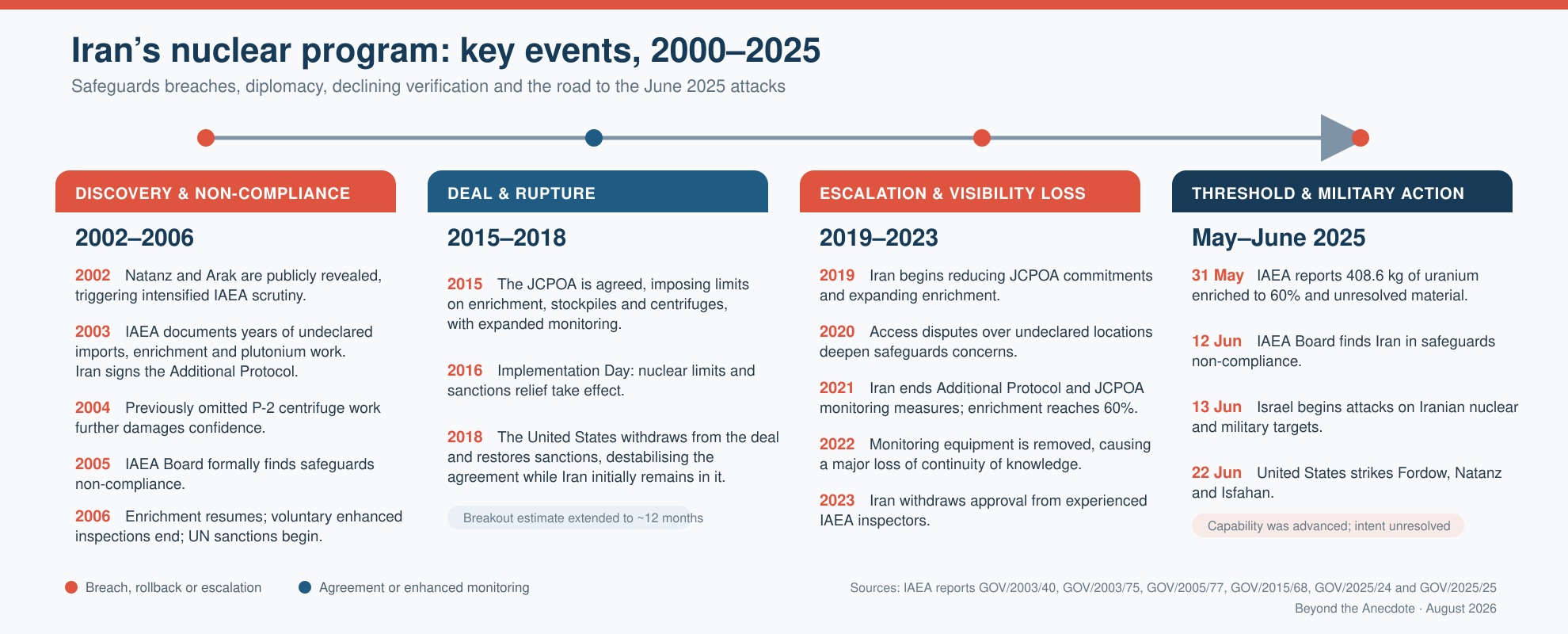
The Additional Protocol would provide the IAEA with wider access to information and locations than Iran’s standard safeguards agreement. Iran signed but did not ratify it and applied it provisionally under the JCPOA before ending that implementation in February 2021.
Iran began reducing its JCPOA commitments in May 2019. By February 2021, it had stopped implementing the agreement’s nuclear-related monitoring provisions, including provisional application of the Additional Protocol. The IAEA subsequently lost access to information that had previously helped it monitor Iran’s centrifuges, uranium production and nuclear-related equipment (IAEA, 2025a).
This did not terminate Iran’s underlying safeguards agreement. Those legal obligations remained in force.
What The IAEA Found
Immediately before the Israeli attacks, the IAEA had identified serious and unresolved safeguards problems.
In a comprehensive assessment issued on 31 May 2025, the Agency concluded that Iran had failed to declare nuclear material and nuclear-related activities at three undeclared locations. The IAEA linked several locations to a structured nuclear program conducted until the early 2000s and found that some of those activities had involved undeclared nuclear material.
Iran had not provided explanations that the IAEA considered technically credible. As a result, the Agency could not determine whether all the relevant nuclear material had been consumed, combined with declared material or remained outside safeguards.
The IAEA also reported that Iran had sanitised some locations and had not disclosed the present whereabouts of certain nuclear material or contaminated equipment. It therefore could not provide assurance that Iran’s nuclear program was exclusively peaceful (IAEA, 2025b).
On 12 June 2025, one day before Israel commenced its attacks, the IAEA Board of Governors formally found that Iran’s failures to provide full and timely cooperation constituted non-compliance with its safeguards agreement.
The Board also found that the Agency was unable to verify that there had been no diversion of nuclear material required to be safeguarded (IAEA Board of Governors, 2025).
That wording is important. Being unable to verify that no diversion occurred is not the same as establishing that material was diverted to a weapons program. However, the inability to account for nuclear material is itself a serious safeguards failure.
The Accumulation Of Highly Enriched Uranium
Iran’s enrichment activities created an additional and more immediate concern.
Most civilian nuclear power reactors use uranium enriched to approximately 3–5 per cent uranium-235. Iran had produced uranium enriched to 20 per cent and 60 per cent. Before the attacks, it was the only non-nuclear-weapon state party to the NPT known to be producing and accumulating uranium enriched to 60 per cent.
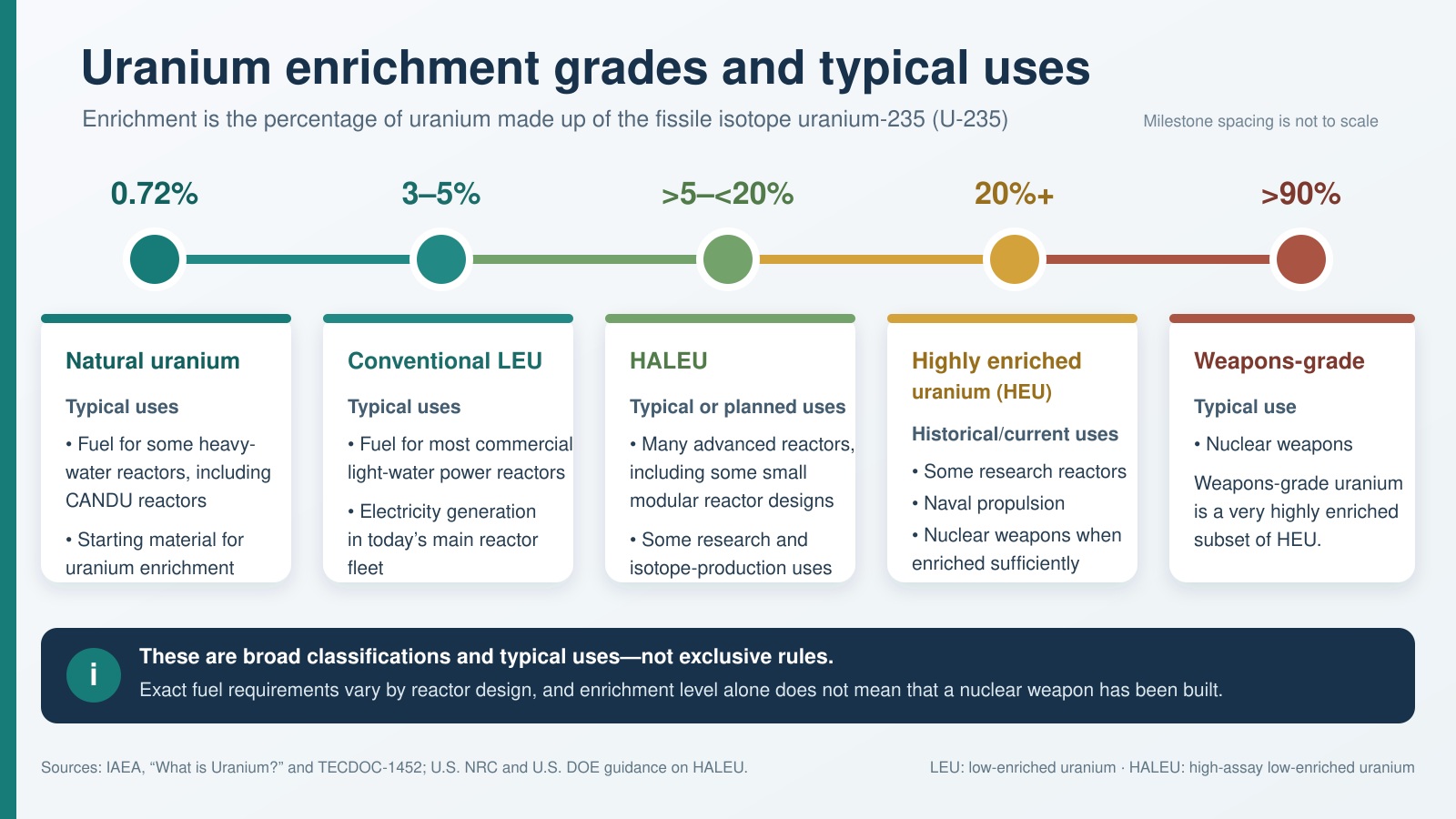
As of 17 May 2025, the IAEA estimated that Iran possessed approximately 408.6 kilograms of uranium enriched to 60 per cent in the form of uranium hexafluoride. This represented an increase of 133.8 kilograms since the previous quarterly report (IAEA, 2025a).
Uranium enriched to 60 per cent is not weapons-grade uranium, which is commonly associated with enrichment to approximately 90 per cent. Nor is enriched uranium by itself a nuclear weapon. Producing a deliverable weapon would require further enrichment and additional conversion, weaponisation and delivery-related work.
Nevertheless, enrichment becomes progressively easier as the concentration of uranium-235 increases. Moving from 60 per cent to weapons-grade material requires substantially less additional enrichment work than moving from natural uranium to 60 per cent.
Iran had therefore developed a capability that could significantly shorten the time required to produce weapons-grade material if its leadership decided to do so.
This was not proof that Iran had made that decision. It was evidence that the practical barrier to implementing such a decision had become dangerously low.
Capability Is Not The Same As Intention
The strongest argument for military action rests on capability, uncertainty and consequence.
Iran had accumulated a large stockpile of highly enriched uranium, expanded its use of advanced centrifuges, restricted enhanced monitoring and failed to resolve questions involving undeclared nuclear material. Its conduct made it increasingly difficult for inspectors to provide confidence that all nuclear activities remained peaceful.
A government assessing the risk could reasonably conclude that waiting for definitive proof of weaponisation might mean waiting until prevention was no longer possible.
However, the publicly available evidence did not establish that Iran had authorised construction of a nuclear weapon.
The IAEA’s May 2025 assessment stated that it had no credible indications of an ongoing undeclared structured nuclear program of the type Iran had operated until the early 2000s. It nevertheless regarded the accumulation of uranium enriched to 60 per cent, unresolved safeguards issues and statements by former Iranian officials as matters of serious concern (IAEA, 2025b).
The United States intelligence community reached a similarly qualified conclusion. Its March 2025 Annual Threat Assessment stated that Iran was not building a nuclear weapon and that Supreme Leader Ali Khamenei had not reauthorised the weapons program suspended in 2003. At the same time, it warned that pressure to reconsider this position had probably increased and that public discussion of nuclear weapons inside Iran had become more acceptable (Office of the Director of National Intelligence, 2025).
The evidence therefore supported a distinction between three possible positions:
- Iran was operating an entirely ordinary civilian nuclear program.
- Iran had decided to construct a nuclear weapon.
- Iran was developing the capability to construct a weapon rapidly if it later chose to do so.
The first position had become increasingly difficult to reconcile with Iran’s enrichment levels, safeguards failures and restricted monitoring. The second was not conclusively established by the public evidence. The third appears most consistent with the information available before the attacks.
A state positioned just below the threshold of building a weapon can still present a major proliferation risk. But the distinction matters when deciding whether that risk justifies initiating a war.
| Question | What the public evidence established before the attacks |
|---|---|
| Had Iran previously conducted undeclared nuclear activities? | Yes |
| Were significant safeguards questions unresolved? | Yes |
| Had Iran accumulated uranium enriched to 60%? | Yes |
| Could Iran move relatively quickly towards weapons-grade uranium? | Yes |
| Had nuclear material been proven to have been diverted into a current weapons program? | No |
| Had Iran been shown to have decided to construct a weapon? | Not conclusively |
The Case That The Attacks Were Warranted
Israel argued that Iran’s combination of advanced enrichment, missile capability, hostile conduct and undeclared nuclear activities presented an existential threat. It described its operation as a pre-emptive action intended to prevent Iran from acquiring nuclear weapons (Israel Defense Forces, 2025).
Several facts strengthen that argument.
First, Iran’s stockpile of uranium enriched to 60 per cent had grown rapidly. If Iran chose to enrich this material further, the time required to produce weapons-grade uranium could be much shorter than under the limits imposed by the JCPOA.
Second, the IAEA could not resolve what had happened to undeclared nuclear material and equipment. Iran’s explanations had repeatedly been rejected as technically inadequate.
Third, the loss of enhanced monitoring meant that the international community had less visibility over Iran’s nuclear activities precisely as its technical capability was increasing.
Fourth, a nuclear weapons program does not need to be publicly declared before it becomes dangerous. If military action could only be contemplated after inspectors confirmed weaponisation, an adversary might be able to conceal or disperse the final stages of the program.
From this perspective, the attacks were intended to prevent a foreseeable threat before it became irreversible.
The United States faced a related but distinct decision. By the time it entered the conflict, Israel and Iran had already exchanged attacks. The Fordow enrichment facility was deeply buried and difficult for Israel to destroy without specialised US weapons. American participation could therefore be presented as a limited intervention aimed at disabling facilities that Israel could not reliably reach.
The Case That The Attacks Were Not Warranted
The case against military action is not dependent on believing that Iran’s nuclear program was harmless.
Iran was in safeguards non-compliance and had developed a deeply concerning nuclear capability. But serious concern does not automatically establish the necessity of immediate military force.
The public evidence had not shown that Iran had made a final decision to build a nuclear weapon. Both the IAEA and US intelligence distinguished between technical capability and an active weapons program.
The IAEA Board’s non-compliance resolution also called for Iran to cooperate, provide credible explanations and remedy its safeguards failures. It did not authorise military action.
Diplomatic negotiations between Iran and the United States had not been conclusively exhausted. A policy combining sanctions relief, enforceable enrichment limits and stronger inspections may still have been possible, even if reaching such an agreement would have been difficult.
Military attacks also carry risks beyond the immediate destruction of facilities. They may encourage a state to withdraw from international agreements, expel inspectors, disperse nuclear activities or conclude that only possession of a completed weapon can prevent future attacks.
Technical knowledge cannot be destroyed in the same way as physical infrastructure. Facilities can be rebuilt, while attacks may reduce the transparency that allows other countries to detect reconstruction.
There is therefore a risk that military action delays a nuclear program in the short term while strengthening the political incentive to acquire a weapon in the longer term.
Warranted Is Not Necessarily The Same As Lawful
Whether an attack is strategically or morally warranted is separate from whether it is lawful under international law.
Article 51 of the United Nations Charter recognises a right of individual or collective self-defence if an armed attack occurs. The legality of anticipatory self-defence against a threat that has not yet materialised remains heavily contested, particularly when the claimed threat is not clearly imminent (United Nations, 1945).
Israel maintained that it acted against an imminent and existential threat. Critics argued that nuclear capability, even when alarming, did not establish an imminent nuclear attack.
A complete legal assessment would also need to consider the broader armed conflict between Iran and Israel, previous direct attacks, necessity, proportionality and the specific targets selected. The safeguards evidence alone cannot resolve those legal questions.
Did The Evidence Justify The Attacks?
The evidence available before 13 June 2025 established several important facts.
Iran had previously conducted undeclared nuclear activities. It had not accounted satisfactorily for all relevant material and equipment. It had restricted enhanced monitoring and accumulated an unprecedented quantity of uranium enriched to 60 per cent for a non-nuclear-weapon state.
These findings justified serious concern, intensive inspections, diplomatic pressure and enforceable restrictions. They also made it reasonable to regard Iran as a nuclear-threshold state capable of moving towards a weapon relatively quickly.
But the publicly available evidence did not establish that Iran had decided to construct a nuclear weapon, that a nuclear attack was imminent or that military action was the only remaining means of preventing one.
That uncertainty did not make inaction risk-free.
If Iran ultimately intended to acquire a weapon, waiting for conclusive proof could have meant waiting until the opportunity for effective intervention had substantially narrowed. Iran could have enriched its existing stockpile further, dispersed nuclear material across concealed or hardened locations, restricted inspections more completely or advanced weaponisation activities that were more difficult to detect. Once weapons-grade material had been produced, or a completed weapon assembled, the military, diplomatic and political costs of attempting to reverse the program would have been considerably greater.
Even without constructing a weapon, remaining at the nuclear threshold could have allowed Iran to shorten its potential breakout time, use that capability as strategic leverage and make future intervention increasingly difficult. It could also have encouraged regional rivals to pursue their own nuclear capabilities.
However, these were risks of what Iran might do, not proof of what it had decided to do. Military action carried its own potentially severe consequences: civilian casualties, regional escalation, retaliation, reduced cooperation with inspectors, the dispersal of nuclear activities and a stronger Iranian incentive to acquire a weapon as protection against future attacks. Destroying facilities could delay the program, but it could not eliminate Iran’s technical knowledge.
The decision therefore involved two competing dangers.
Acting too early risked initiating or expanding a war on the basis of capability and suspected intention rather than conclusive evidence of weaponisation. Acting too late risked allowing Iran to reach a point at which preventing weapon acquisition became far more difficult, or could be attempted only through a larger and more dangerous conflict.
| Acting too early | Acting too late |
|---|---|
| War initiated without conclusive evidence of weaponisation | Weapons-grade material may be produced before intervention |
| Civilian casualties and regional escalation | Material and equipment may be dispersed or concealed |
| Reduced cooperation with inspectors | Hardened facilities may become more difficult to reach |
| Stronger Iranian incentive to acquire a deterrent | Iran may reach an effectively irreversible threshold |
| Facilities may be rebuilt | Regional nuclear proliferation may accelerate |
| A nuclear attack could occur |
The strongest defensible conclusion is therefore not that the attacks were clearly warranted or clearly unwarranted. It is that they represented a preventive choice made under profound uncertainty.
Supporters of the attacks prioritised the potentially irreversible consequences of waiting too long. Opponents prioritised the consequences of using military force without conclusive evidence that Iran had decided to build a weapon.
The disagreement ultimately turns on the standard of proof society should demand before military force is used and how it should weigh the consequences of a mistaken decision.
Is demonstrated technical capability, safeguards non-compliance and a rapidly narrowing opportunity to intervene sufficient? Or should military action require direct evidence of a decision to build a weapon, the diversion of nuclear material or an imminent attack?
How that threshold is answered will largely determine whether the Israeli and United States attacks are viewed as necessary prevention, or as a premature escalation that may have made the long-term nuclear risk more difficult to control.
What do you think?
Estimated completion time: 15 minutes
References
International Atomic Energy Agency (IAEA) (2025a) Verification and monitoring in the Islamic Republic of Iran in light of United Nations Security Council resolution 2231 (2015), GOV/2025/24, 31 May. Vienna: IAEA. Accessed 2 August 2026.
International Atomic Energy Agency (IAEA) (2025b) NPT Safeguards Agreement with the Islamic Republic of Iran: Comprehensive assessment, GOV/2025/25, 31 May. Vienna: IAEA. Accessed 2 August 2026.
International Atomic Energy Agency Board of Governors (2025) NPT Safeguards Agreement with the Islamic Republic of Iran: Resolution adopted on 12 June 2025, GOV/2025/38. Vienna: IAEA. Accessed 2 August 2026.
Israel Defense Forces (2025) The IDF has launched a preemptive strike against Iran’s nuclear program, 13 June. Accessed 2 August 2026.
Office of the Director of National Intelligence (2025) Annual Threat Assessment of the U.S. Intelligence Community. Washington, DC: Office of the Director of National Intelligence. Accessed 2 August 2026.
United Nations (1945) Charter of the United Nations: Chapter VII. New York: United Nations. Accessed 2 August 2026.
United Nations (1970) Treaty on the Non-Proliferation of Nuclear Weapons, United Nations Treaty Series, vol. 729, no. 10485. New York: United Nations. Accessed 2 August 2026.
United States Department of Defense (2025) Hegseth, Caine laud success of U.S. strike on Iran nuclear sites, 22 June. Accessed 2 August 2026.