
How Beyond the Anecdote approaches political perspectives
Beyond the Anecdote uses structured questionnaires, policy comparisons, evidence review and comparative analysis to explore how political views are formed, where they align and where they diverge.
The project does not assume that political disagreement can be reduced to a single left–right scale, or that every disagreement can be resolved by facts alone.
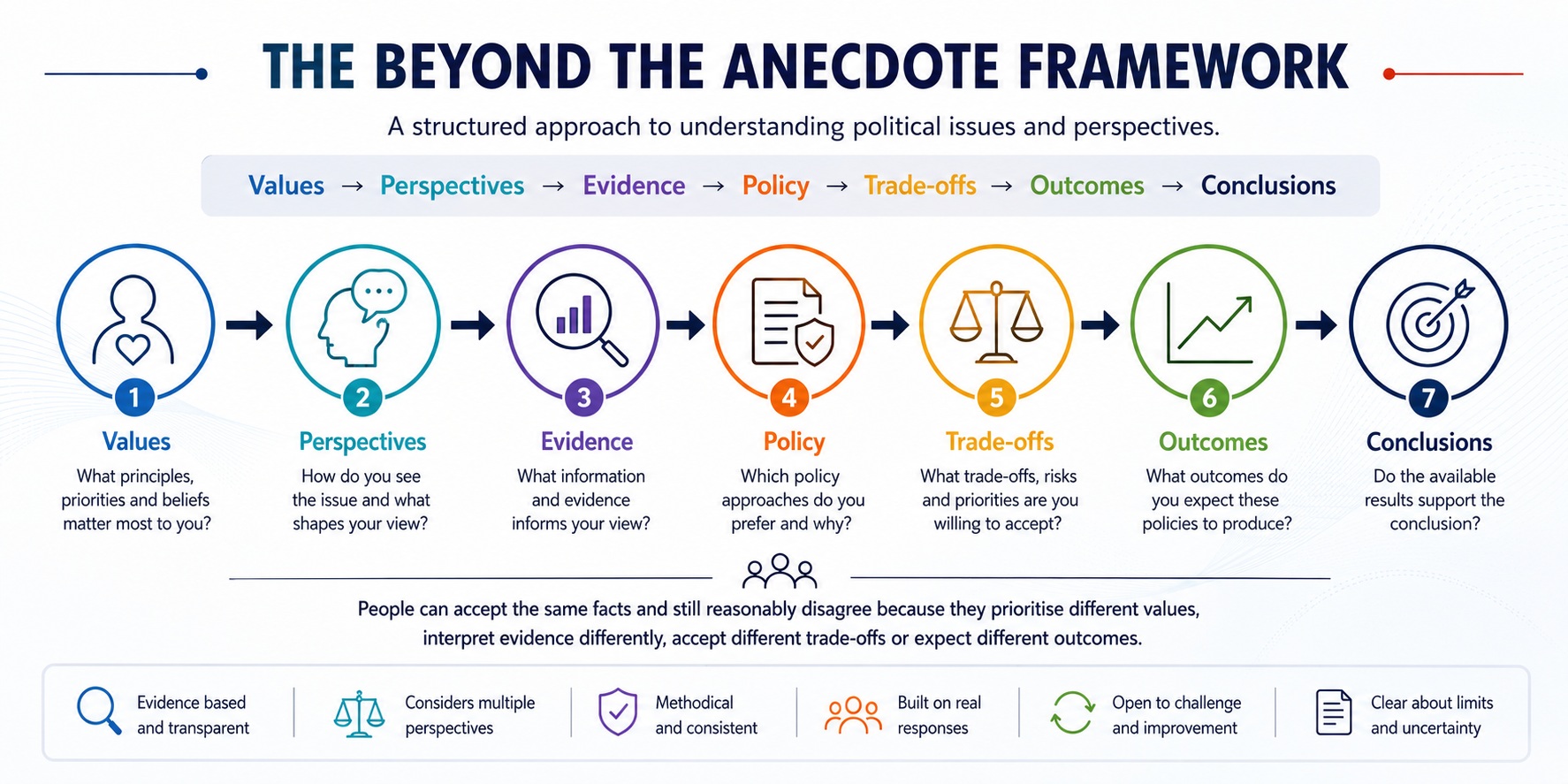
People can accept the same evidence and still reasonably disagree because they place different weight on values, risks, rights, responsibilities, priorities and trade-offs.
A useful way to think about the framework is:
Values → Perspectives → Evidence → Policy → Trade-offs → Outcomes → Conclusions
Different parts of Beyond the Anecdote examine different stages of that process.
The purpose is not to identify a single “correct” political worldview, but to make the structure behind different positions easier to see.
Political Profiles
Political profiles are built from responses across multiple questionnaires rather than from a single ideological label.
Different questionnaires may explore:
- economic and social outlook;
- moral values;
- personality;
- liberty and public order;
- national and international outlook;
- institutions and evidence;
- foreign policy;
- policy preferences; and
- views on specific political and social issues.
These dimensions are deliberately treated separately.
A person’s position on one issue does not automatically determine their position on another.
The aim is therefore to build a multidimensional picture of political outlook, rather than infer an entire worldview from a single left–right score.
Questionnaire results should be interpreted as analytical indicators rather than definitive descriptions of political identity.
Surveys and Question Design
Beyond the Anecdote uses surveys to explore political and social views and, where useful, the reasoning behind them.
Questions may examine:
- values and moral principles;
- factual beliefs;
- perceptions of evidence;
- policy preferences;
- acceptable trade-offs;
- expected outcomes; and
- views about comparable situations.
Some surveys use conditional questions, allowing different follow-up questions depending on earlier responses.
This can help identify where perspectives begin to diverge.
Two people may prefer different policies because they disagree about the facts, interpret the same evidence differently, prioritise different values or accept different risks and trade-offs.
Questions are intended to be clear, understandable and focused on meaningful differences in position.
Perfect neutrality in wording cannot always be guaranteed, particularly on highly contested subjects. Questions may therefore be revised where testing identifies ambiguity, misleading wording, unnecessary bias or poor differentiation between positions.
Questionnaire Scoring
Questions used for political profiling are mapped to the dimensions they are intended to measure.
Responses are combined and normalised to produce positions on the relevant scales.
Exact numerical scores should not be treated as definitive political labels.
Small differences between respondents may have little practical meaning, and the pattern of answers across multiple dimensions is often more informative than any single score.
Question sets are reviewed for balance, including whether:
- both ends of a dimension are represented fairly;
- one theme is overrepresented;
- multiple questions unintentionally measure the same idea;
- wording favours one position; or
- a question is measuring something other than the intended dimension.
Questionnaires may evolve as weaknesses are identified. Material changes to scoring or meaning should be treated transparently so historical results are not silently reinterpreted.
Party Policy Matching
Party-policy comparisons use a different methodology from political-profile questionnaires.
They compare a respondent’s answers on specific policy questions with documented positions attributed to political parties.
Party alignment therefore means similarity on the policies included in the comparison.
It does not mean that:
- the respondent endorses the party overall;
- the party represents all of their values;
- the respondent should vote for that party; or
- every issue relevant to an election has been measured.
Party positions may be derived from published policy platforms, election policies, official statements, legislation, voting records and other authoritative party material.
Where a party’s position cannot reasonably be established, it should not be represented with false precision.
Evidence and Source Selection
Evidence-based articles and explanatory material draw on credible and relevant sources appropriate to the question being examined.
Depending on the subject, these may include:
- government statistics and administrative data;
- legislation and official records;
- parliamentary and government publications;
- international organisations;
- peer-reviewed academic work;
- established research organisations;
- reputable polling organisations;
- original speeches and policy documents; and
- high-quality reporting where primary material is unavailable.
Primary sources are preferred where practical.
Sources are considered in light of factors such as authority, methodology, sample size, transparency, recency, relevance and acknowledged limitations.
The fact that a source is authoritative does not mean every interpretation of it is necessarily correct.
Where practical, links and citations are provided so readers can examine the underlying material themselves.
Evidence and Analysis
When examining contested claims, Beyond the Anecdote aims to distinguish between:
- established facts;
- estimates;
- assumptions;
- forecasts;
- disputed interpretations;
- causal claims; and
- political or moral judgments.
Relevant competing explanations should be considered where they materially affect the conclusion.
Facts do not automatically determine policy.
Moving from evidence to a preferred policy usually requires judgments about values, rights, costs, risks, priorities and trade-offs.
Where policy outcomes are examined, consideration may include effectiveness, costs, unintended consequences, distribution of benefits and burdens, implementation constraints and measurable outcomes.
Conclusions should reflect the strength and limitations of the available evidence.
Respondent Results and Population Results
Individual results describe how one person answered a questionnaire.
Aggregate results describe how participating respondents answered.
Unless explicitly stated otherwise, Beyond the Anecdote uses open, voluntary participation rather than probability sampling.
This means respondents may differ substantially from the wider population.
Aggregate findings should therefore generally be interpreted as describing the people who participated, rather than the general population or electorate.
Where percentile-style comparisons are shown, they describe a respondent’s position relative to other recorded respondents.
They should not be interpreted as estimates of where that person sits within the wider population.
Demographics and Small Groups
Some questionnaires allow respondents to provide optional demographic information so patterns between groups can be explored.
These may include characteristics such as age group, gender, education, religion, location, occupation, political alignment or information sources.
Small groups can produce unstable percentages and create privacy risks.
Minimum-response thresholds may therefore be applied before subgroup results are displayed.
Where a result is withheld because too few responses are available, this does not mean those responses were invalid.
Response Integrity and Data Cleaning
Open online questionnaires can be affected by duplicate, automated, test or deliberately manipulative responses.
Beyond the Anecdote may apply integrity checks to identify submissions that warrant review.
Aggregate analysis may exclude responses that are:
- confirmed duplicates;
- incomplete where completion is required;
- technically corrupted;
- test submissions; or
- otherwise unsuitable for the analysis being performed.
Responses should not be removed simply because they are politically inconvenient or statistically unusual.
Extreme but genuine responses remain valid observations.
Statistical Interpretation
Survey results are primarily descriptive unless otherwise stated.
Percentages, averages, distributions and group comparisons describe patterns within the available responses.
A relationship between two variables does not by itself demonstrate that one caused the other.
Particular caution is required when sample sizes are small, respondents are self-selected, many subgroup comparisons are being made or differences are numerically small.
Statistical precision should not be implied where the underlying data does not justify it.
Independence and Perspective
Beyond the Anecdote is an independent project and is not affiliated with any political party, political organisation or advocacy group.
No writer, questionnaire designer or publication can guarantee complete freedom from perspective.
Topic selection, framing, wording and interpretation all involve judgment.
The objective is therefore not to claim perfect neutrality, but to pursue transparency, consistency and openness to challenge.
The same standards should be applied regardless of whether a result benefits a position associated with the political left, right or neither.
Readers are encouraged to inspect sources, challenge interpretations and identify relevant evidence or perspectives that may have been overlooked.
Corrections and Updates
Information, political policies and available evidence can change.
Material factual errors should be corrected when identified.
Articles and explanatory material may also be updated where significant new evidence becomes available.
Questionnaires may evolve as better wording, scoring or design approaches are identified.
Where changes materially affect interpretation or comparability, they should be handled transparently rather than silently rewriting earlier results.
Limitations
Beyond the Anecdote is an independent survey, analysis and commentary project rather than an academic institution or professional polling organisation.
Unless specifically stated otherwise:
- content has not undergone formal academic peer review;
- surveys use voluntary rather than probability sampling;
- respondents may differ from the wider population;
- questionnaire scores are constructed analytical measures rather than clinical or psychological diagnoses;
- party-policy comparisons depend on the policies and questions included;
- external datasets remain subject to the limitations of their original publishers; and
- conclusions may change when better information becomes available.
These limitations do not prevent useful exploration of political perspectives.
They simply define what the results can — and cannot — reasonably tell us.
The objective of Beyond the Anecdote is not to reduce people to a political label, but to make the values, perspectives, evidence, policy preferences and trade-offs behind those labels easier to understand.