

When Disagreement Becomes Division
Political disagreement is unavoidable.
People have different values, experiences and priorities. They will disagree about immigration, crime, taxation, welfare, climate policy, foreign affairs and the role of government. That disagreement is not necessarily unhealthy. Democracy depends on competing ideas being tested, challenged and improved.
The deeper problem begins when debate is no longer about finding the best response to a problem. Instead, it becomes about proving that our side is right and that the other side is not merely mistaken, but ignorant, selfish, dangerous or immoral.
Facts are selected according to whether they help our side. Contradictory evidence is dismissed or explained away. The worst representatives of the opposing position are treated as typical, while the worst behaviour from our own side is treated as an exception.
Under these conditions, finding common ground becomes extremely difficult.
The objective shifts from understanding the problem to defending the narrative.
Not because society lacks shared concerns, but because acknowledging a valid point made by the other side can feel like surrender.
When Disagreement Becomes Identity
Political beliefs have always been shaped by family, class, religion, geography and personal experience.
But politics can become more than a collection of policy preferences. It can become part of a person’s identity, a way of deciding who belongs, who can be trusted and who represents a threat.
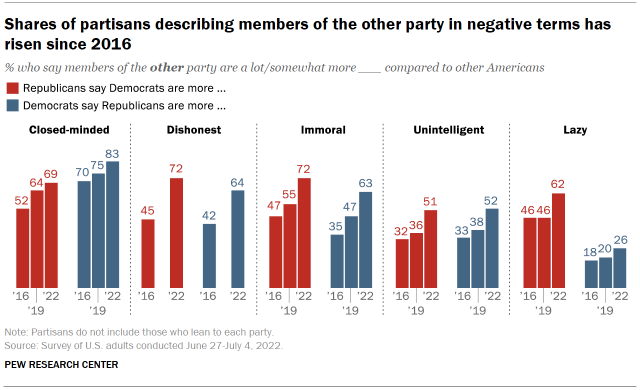
Researchers use the term affective polarisation to describe hostility toward political opponents as people, rather than disagreement with their policies alone.
Once politics becomes part of identity, evidence becomes harder to assess impartially. Accepting that an opponent is correct about something may appear to weaken your own group. Questioning your side’s preferred explanation can be treated as disloyalty. Admitting uncertainty may be interpreted as weakness.
The question:
Is this claim true?
can gradually be replaced by a more personal one:
What would accepting this claim say about me and the people I support?
That is a much harder question to answer honestly.
Although these findings relate to the United States, they provide a clear example of how political disagreement can develop into hostility toward opposing voters.
Narratives Make the World Simpler
Political narratives are attractive because they offer clear explanations for complicated events. One side may explain social problems through inequality, discrimination and institutional failure. Another may emphasise personal responsibility, cultural decline or failures of enforcement.

Each perspective can identify genuine problems. The difficulty begins when one framework becomes the explanation for almost everything. Evidence supporting the narrative is accepted quickly, while contradictory evidence is subjected to greater scrutiny. Mistakes by opponents are treated as revealing their true character. Mistakes by allies are explained as context, misunderstanding or isolated behaviour.
This does not always involve deliberate dishonesty. People are often unaware that they are applying different standards. We naturally notice information that confirms what we already believe and resist information that threatens an established worldview.
Online political spaces can intensify this tendency. Careful explanations require context and uncertainty. Viral political messages usually require a villain, a victim and a confident conclusion. Outrage spreads more easily than nuance, and certainty attracts more attention than caution. As a result, the most emotionally satisfying argument can become more visible than the most accurate or constructive one.
When Winning Replaces Solving
Most political issues involve several distinct questions:
- What is happening?
- How widespread is it?
- What is causing it?
- Who is affected?
- What outcome should society prioritise?
- Which policy is most likely to work?
- What trade-offs are acceptable?
- How will success be measured?
These questions should be examined separately. Instead, debate often begins with a preferred conclusion and works backwards.
A policy becomes associated with compassion, justice, freedom, safety or patriotism. Once framed in those terms, questioning whether it will work can be treated as opposition to the moral objective itself.
Someone questioning a welfare program may be accused of lacking compassion. Someone challenging a policing strategy may be accused of not caring about victims. A person questioning immigration levels may be labelled hostile to migrants. Someone criticising military action may be accused of indifference to national security.
This avoids the most important question:
Will the proposed policy actually produce the outcome being promised?
Good intentions do not guarantee good results.
A policy can be motivated by compassion and still fail. It can address a genuine problem while creating serious unintended consequences. It can provide visible benefits to one group while shifting less visible costs onto another.
Criticism of a policy does not necessarily mean rejection of its objective.
People can agree that a problem is serious while disagreeing about its cause. They can support the same goal while preferring different methods. They can share a moral principle while assigning different weight to competing risks.
Those distinctions disappear when every disagreement is treated as evidence of moral character.
What Common Ground Actually Means
Common ground is often misunderstood as finding a comfortable position halfway between two opposing views.
That is not always possible, and it is not always desirable.
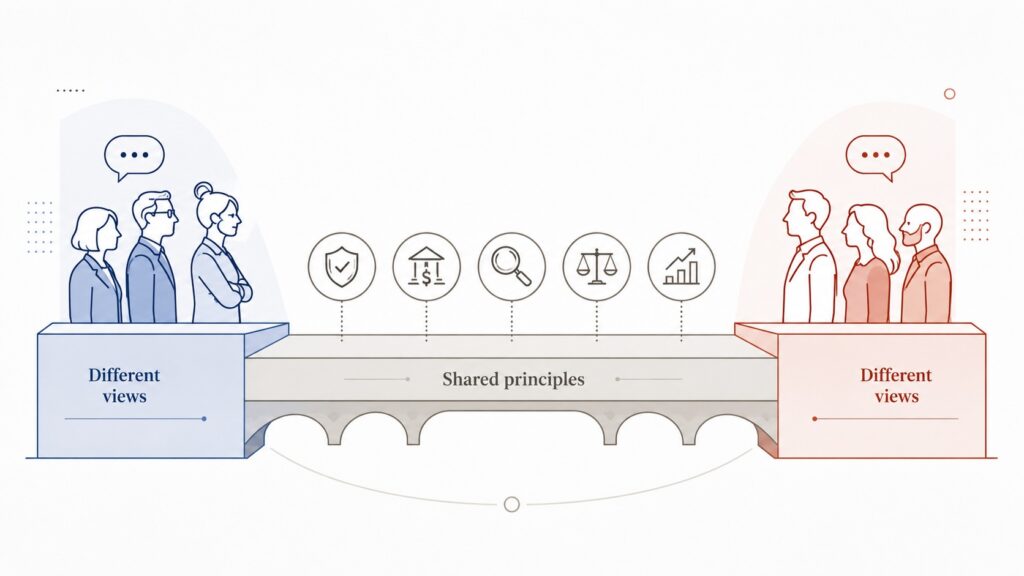
The truth does not necessarily sit in the middle. One side may have stronger evidence. Some compromises may be incoherent, and some principles may be genuinely incompatible. Common ground should instead begin with identifying what people already agree on. They may agree that:
- a problem exists
- innocent people should be protected
- public money should be used effectively
- government power requires oversight
- laws should be applied consistently
- people should be treated as individuals
- policies should be judged by outcomes
Agreement at this level does not settle the debate. It creates a foundation for identifying where the disagreement actually begins.
Is the dispute about the facts? The cause of the problem? The moral priority? The likely effectiveness of a policy? Or the trade-offs people are willing to accept?
That is far more useful than assuming disagreement proves the other person does not care.
Common ground is not
- automatically splitting the difference
- assuming both sides are equally correct
- avoiding difficult disagreement
Common ground can be
- agreeing on the problem
- agreeing on standards of evidence
- agreeing on desired outcomes
- identifying the real point of disagreement
Common ground does not require shared conclusions. It begins with shared standards for examining the disagreement.
A Better Way to Disagree
The purpose of Beyond the Anecdote is not to eliminate political disagreement. It is to make disagreement clearer.
Political claims will be examined through a structured sequence:
Concern → moral value → specific claim → evidence → established facts → policy options → measurable outcomes
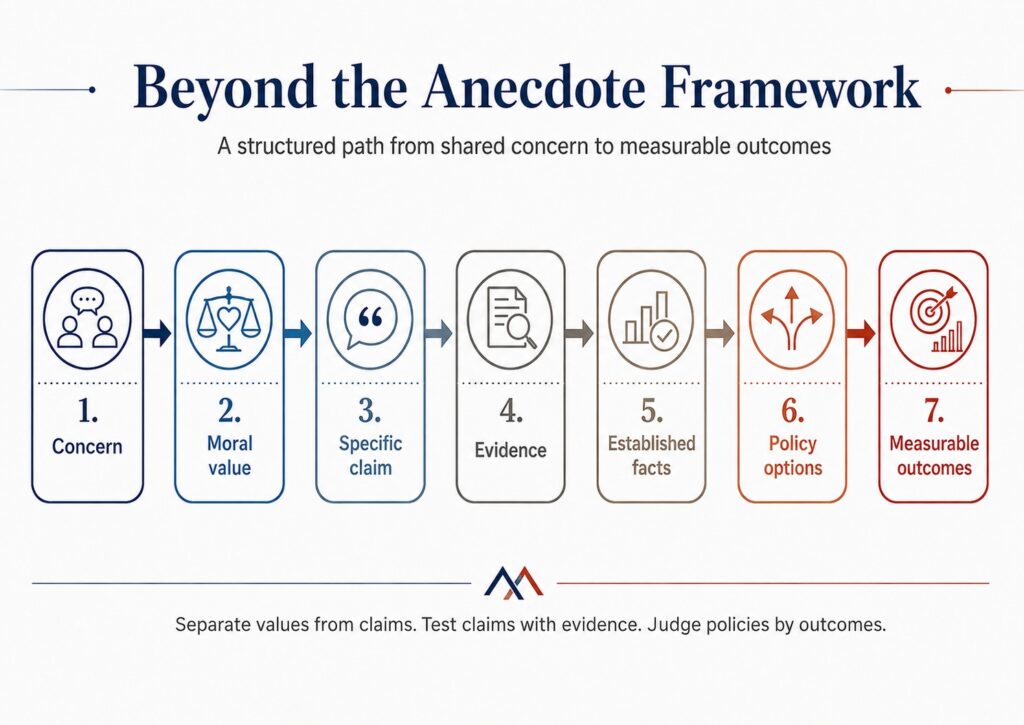
Begin with the concern.
What problem is being identified? What value is being protected? Fairness, liberty, security, equality, responsibility, compassion or social cohesion?
Then state the claim precisely.
What is allegedly happening? How often? To whom? Compared with what?
Next, examine the evidence.
Is the information reliable and representative? Has important context been excluded? What evidence points in the opposite direction?
Only then should policy options be assessed.
Does the proposal address the cause of the problem? What are its likely benefits, costs and unintended consequences? Are there better alternatives?
Finally, connect the policy to measurable outcomes.
What would success look like? Over what period? What result would show that the policy has failed or needs to change?
This process will not always produce agreement. It may reveal that people accept the same facts but prioritise different values, share the same objective but assess risk differently, or have overlooked relevant evidence.
Most importantly, it changes the purpose of the conversation.
The goal is no longer to defend a political identity at any cost. It is to identify where the disagreement occurs and determine which conclusions the evidence can reasonably support.
Beyond the Anecdote
Anecdotes matter. They can expose failures, humanise suffering and identify questions worth investigating.
But an anecdote cannot tell us, by itself, how common something is, what caused it or which policy will improve it. Neither can a political narrative.
We do not need to agree on everything. We do need to distinguish disagreement from malice, uncertainty from ignorance and criticism of a policy from hostility toward the people it is intended to help.
Being correct matters. But proving that your opponents are wrong is not the same as solving the problem.
Beyond the Anecdote begins with a different question:
What would we believe, and what policy would we support, if being right mattered less than getting the outcome right?
References and Further Reading
- Pew Research Center — As Partisan Hostility Grows, Signs of Frustration With the Two-Party System
- Pew Research Center — Americans See Little Bipartisan Common Ground, but More on Foreign Policy Than on Abortion, Guns
- OECD — OECD Survey on Drivers of Trust in Public Institutions: 2024 Results
- Hobolt, Lawall and Tilley — The Polarizing Effect of Partisan Echo Chambers
- Fishkin, Siu, Diamond and Bradburn — Is Deliberation an Antidote to Extreme Partisan Polarization? Reflections on “America in One Room”