Political Compass: More Than Left and Right
Political views rarely fit neatly on a single left–right line.
Someone may support publicly funded healthcare while preferring private markets in other areas. A person can hold socially progressive views on some issues while supporting stricter approaches to policing, borders or national security. Two people may vote for the same party while holding very different views about economic ownership, migration, gender politics, institutions or foreign policy.
The Beyond the Anecdote Political Compass separates some of these differences. Its 20 core questions provide a two-dimensional picture of your economic and social outlook. You can then answer 32 optional questions to receive a more detailed profile across ten additional political outlooks.
What does the political compass measure?
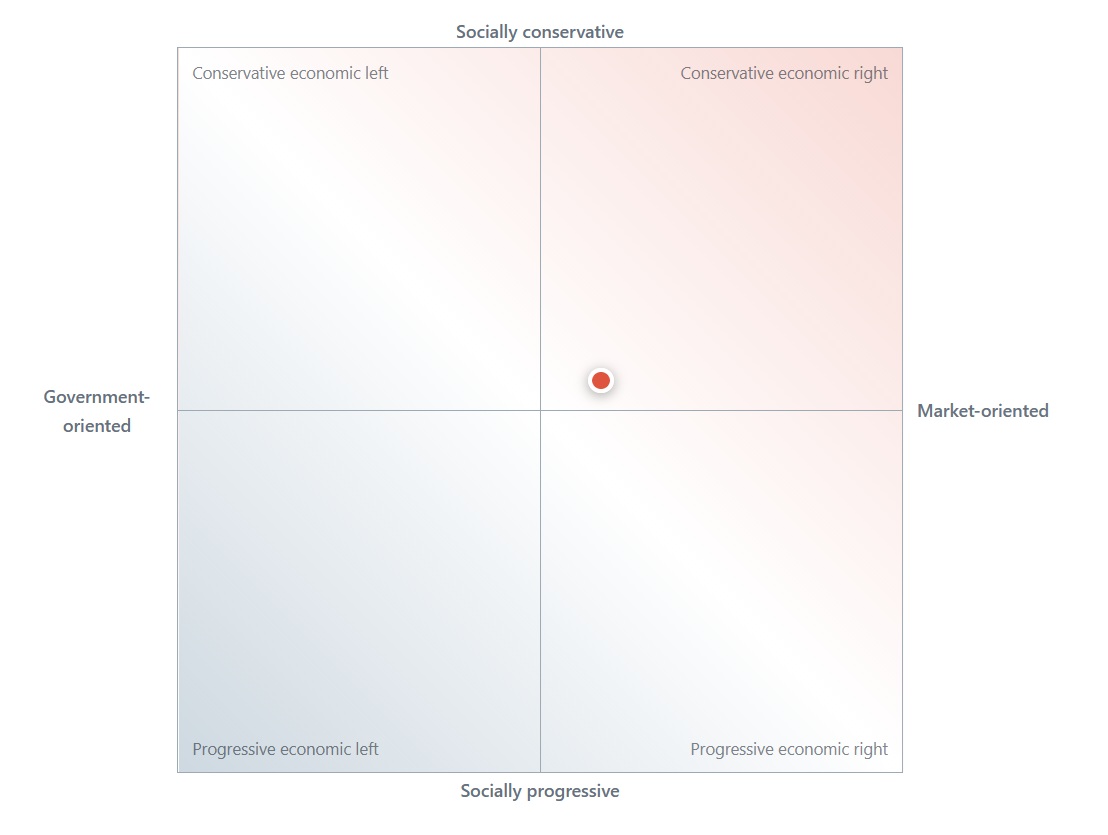
Your main result is plotted using two independent axes:
- Economic outlook: Government-oriented to market-oriented
- Social outlook: Socially progressive to socially conservative
These axes are measured separately. Your economic position does not determine your social position and vice versa.
Economic outlook
The horizontal axis considers the balance you strike between different approaches to ownership, markets, taxation, welfare and the economic role of government.
Government-oriented
Greater emphasis on public, worker or collective ownership; public operation of essential industries; universal services; welfare provision; and reducing differences in income and wealth through taxation and public policy.
Market-oriented
Greater emphasis on private ownership, competitive markets, privately negotiated employment conditions, personal responsibility and limiting government’s economic role primarily to protecting property rights, enforcing contracts and preventing fraud.
This is not simply a measure of whether you support or oppose government. Many people support private markets alongside public healthcare, education or welfare. Others may favour government involvement in essential industries while opposing extensive redistribution.
Your result reflects the overall pattern of your answers rather than your position on any single economic policy.
Social outlook
The vertical axis considers the balance you strike across migration, sex and gender, criminal justice, abortion and family structure.
Socially progressive
Greater emphasis on freedom of movement and migration openness, legal recognition of gender identity, alternatives to imprisonment, legal access to abortion and equal institutional recognition of different family structures.
Socially conservative
Greater emphasis on border controls and migration screening, biological sex in laws and policies, policing and public order, protection of human life before birth and the social value of traditional family structures.
A socially conservative result does not automatically mean someone is economically market-oriented. Likewise, a socially progressive result does not automatically mean someone supports extensive government control of the economy.
That is why the compass uses two independent axes rather than a single left–right scale.
Optional Extended Political Profile
Two axes cannot capture every important political disagreement.
After completing the 20 core questions, you can answer 32 additional questions to receive ten independently scored indicators grouped into five broader outlook areas.
These indicators do not change the position of your main compass dot. They provide additional context about the priorities, principles and policy instincts underlying your broader political outlook.
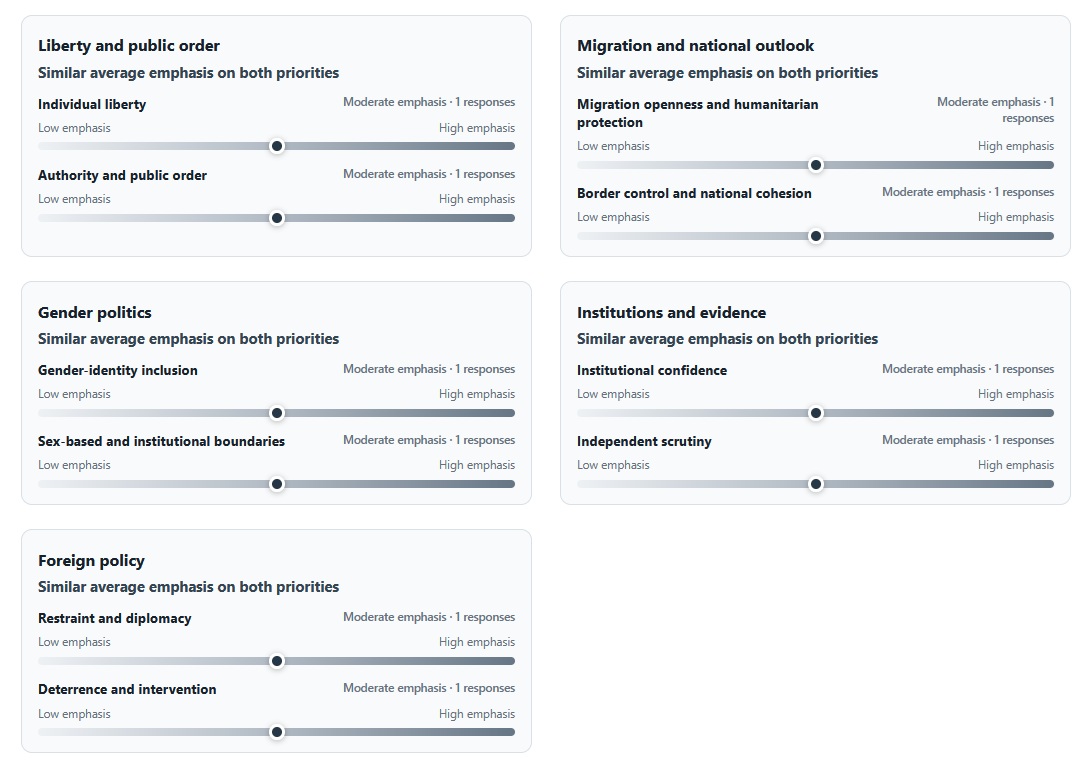
Each indicator is measured separately from low emphasis to high emphasis. The two indicators within a group are not opposite ends of a single scale. It is possible to place high emphasis on both, low emphasis on both or substantially more emphasis on one than the other.
| Outlook group | First indicator | Second indicator |
| Liberty and public order | Individual liberty | Authority and public order |
| Migration and national outlook | Migration openness and humanitarian protection | Border control and national cohesion |
| Gender politics | Gender-identity inclusion | Sex-based and institutional boundaries |
| Institutions and evidence | Institutional confidence | Independent scrutiny |
| Foreign policy | Restraint and diplomacy | Deterrence and intervention |
These additional indicators can distinguish between people who occupy similar positions on the main compass but hold different views about:
- freedom of speech, privacy and police powers;
- refugee protection, immigration enforcement and national integration;
- gender identity, institutional neutrality and sex-based rules;
- confidence in established institutions and the need for independent scrutiny; and
- military restraint, alliance obligations, deterrence and intervention.
For example, someone may strongly support individual liberty while also placing considerable emphasis on public order. Another person may support humanitarian refugee protection while also favouring firm integration requirements and enforcement against unlawful migration.
The extended profile is designed to show these combinations rather than assume that every political priority must come at the expense of another.
How should I interpret my result?
Your result is a structured summary of your answers. It is not a diagnosis, a party recommendation or a permanent political identity.
The Political Compass can help you:
- identify where your views are consistent or mixed;
- distinguish high-welfare capitalism from socialism and more minimal-state economic positions;
- separate economic and social instincts that are often collapsed into one label;
- see how you approach migration, gender politics, criminal justice, institutions and foreign policy;
- compare your self-described political identity with your responses; and
- discuss political disagreements more precisely.
Two people with similar scores may still have very different reasons for holding their views.
They may begin with different moral principles, trust different evidence or make different assumptions about the likely consequences of a policy. Conversely, people may share the same underlying objective while disagreeing about which policy is most likely to achieve it.
The result shows the pattern of your answers. It cannot explain every reason behind them.
What the compass does not tell you
The Political Compass does not establish:
- whether a political belief is factually correct;
- whether a position is morally justified;
- which political party you should support;
- how you would respond to every political issue; or
- why you hold a particular view.
Question wording, the subjects included and your interpretation of each statement can all affect your result.
Political views can also change as circumstances, evidence and personal priorities change. Your result should therefore be understood as a snapshot of your current responses to this particular set of questions.
The purpose is not to reduce you to a label. It is to make the pattern and complexity of your views easier to see.
Ready to see where you land?
Answer the 20 core statements to receive your two-axis Economic and Social Political Compass result.
You can then continue to the optional 32-question Extended Political Profile to receive ten additional scores across five broader areas of political outlook.
The Beyond the Anecdote Political Compass is an independent project. It is not affiliated with any political party or any campaigning organisation.